
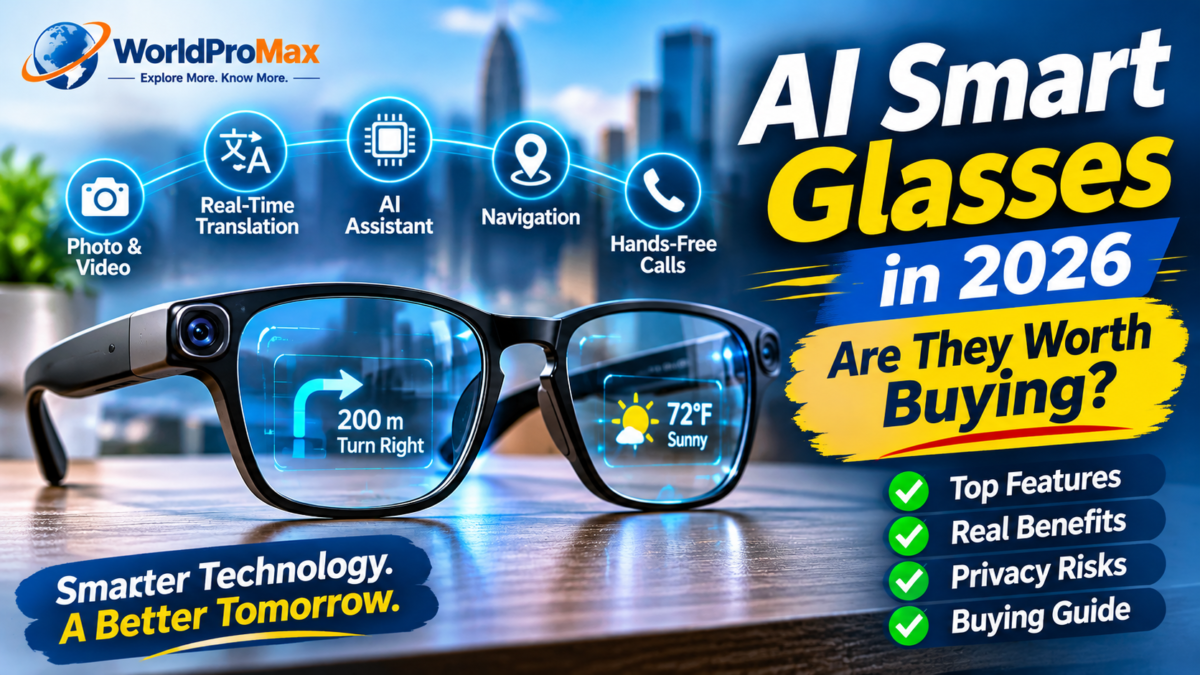
Artificial intelligence is becoming a bigger part of our everyday lives. We already use AI through smartphones, computers, and smart home devices. Now, AI is moving into another category of technology: AI smart glasses.
Imagine walking through New York and seeing a famous building. Instead of taking out your phone and searching online, you could ask an AI assistant about the building and hear the answer through your glasses.
You may also be able to get help understanding foreign-language signs, capture hands-free photos, or access useful information while traveling.
But are AI Smart Glasses 2026 products really worth buying, or are they just another technology trend? Let’s explore their features, benefits, limitations, and privacy concerns.
1. What Are AI Smart Glasses?
AI smart glasses look similar to regular eyeglasses or sunglasses but include additional technology. Depending on the model, they may have:
- Built-in cameras and microphones
- Speakers for calls and AI responses
- Wireless connectivity
- Voice-controlled AI assistants
- Small displays on selected models
Unlike regular glasses, smart glasses can help you access information, take photos, listen to audio, and interact with AI.
Many models connect to a smartphone for internet access and additional processing. Their capabilities depend on the specific device.
2. How Do AI Smart Glasses Work?
AI smart glasses use several components to provide their features:
- Camera: Captures photos and videos.
- Microphone: Listens to voice commands.
- Speakers: Play AI responses, calls, and other audio.
- AI Assistant: Processes questions and provides information.
- Smartphone Connection: Supports internet access and compatible apps.
- Battery: Powers the device.
For example, you could ask, “What is the history of this building?” The microphone captures your question, the connected AI service processes it, and the answer may be delivered through the glasses’ speakers.
Some models include displays, while others focus mainly on audio and camera features.
3. Key AI Smart Glasses Features in 2026
AI-powered eyewear is evolving, with companies exploring new ways to combine AI assistants and wearable technology. Google’s Gemini-powered intelligent eyewear plans through Android XR are one example.
Here are some features to look for:
Voice AI Assistant: Ask questions and access information without taking out your phone.
Real-Time Translation: Supported devices may help translate signs, menus, and conversations. Language support varies by model.
Photo and Video Recording: Built-in cameras can capture photos and videos hands-free.
Navigation: Compatible devices may provide directions and information about nearby places.
Calls and Messages: Some models connect to smartphones to support calls and messaging features.
AI Visual Assistance: Ask questions about objects, buildings, or products using information captured by the camera.
Not every model includes all these features, so check the exact product specifications before buying.
4. Practical Benefits of AI Smart Glasses
AI smart glasses may be useful in several everyday situations.
- Hands-free convenience: Voice assistance can make it easier to access information while walking, cooking, or traveling.
- Travel assistance: Translation, directions, and local information may help when exploring a new city.
- Content creation: Vloggers and creators can capture first-person photos and videos.
- Everyday learning: You can ask about unfamiliar objects, plants, and landmarks.
- Accessibility: Visual assistance may help some blind or low-vision users understand printed text and everyday objects.
These features can be helpful, but AI-generated information should be checked when accuracy is important. Never use visual interactions while driving, and always respect other people’s privacy when recording.
5. Popular AI Smart Glasses and Platforms
Several major technology and eyewear brands are exploring smart glasses.
Ray-Ban Meta Smart Glasses: Developed through a partnership between Meta and Ray-Ban, these glasses focus on camera, audio, and AI features in a familiar eyewear design.
Google Gemini Intelligent Eyewear: Google has introduced its vision for Gemini-powered eyewear, including collaborations with eyewear brands such as Gentle Monster and Warby Parker.
Android XR Glasses: Android XR is a platform designed to support AI and extended reality experiences on compatible devices.
Product availability and features can differ between countries. Always check official product information for the latest details.
6. Privacy and Security Risks
Smart glasses can raise important privacy concerns because some models include cameras and microphones.
Recording Without Permission: Avoid recording people without appropriate permission. Follow local laws and recording rules.
Personal Data Collection: Voice commands, photos, location information, and app activity may be processed depending on the device and service.
Account Security: Use strong passwords, enable two-factor authentication when available, and review app permissions.
Public Places: Offices, hospitals, schools, and private properties may restrict recording. Check the rules before using camera features.
Before buying, read the manufacturer’s privacy policy and understand how recording indicators and personal data controls work.
7. What to Check Before Buying
Do not choose AI smart glasses based on appearance alone. Compare these important factors:
- Battery life: How long does it last during normal use?
- Camera quality: Are photos and videos suitable for your needs?
- AI features: Does it support voice assistance and visual AI?
- Compatibility: Does it work with your Android phone or iPhone?
- Comfort: Can you wear it for extended periods?
- Privacy: Does it provide recording indicators and useful privacy controls?
- Warranty: Is reliable customer support available?
- Price: Are the features worth the cost?
If you wear prescription glasses, check whether prescription lenses are supported.
8. Can AI Smart Glasses Replace Smartphones?
Not yet. Smartphones still offer large displays, powerful apps, typing, gaming, video editing, and multitasking.
Smart glasses are mainly designed for quick information access and hands-free assistance. They may help you answer questions or capture photos, but writing long emails and editing professional videos are still easier on a phone or computer.
For now, think of AI smart glasses as an additional device rather than a smartphone replacement.
9. Are AI Smart Glasses Worth Buying in 2026?
It depends on your needs and budget.
They may be worth considering if you travel frequently, create content, enjoy hands-free photography, or want an AI assistant within easy reach.
However, if you only need regular sunglasses, an expensive AI-powered device may not be necessary.
Compare battery life, comfort, camera quality, privacy controls, compatibility, and price before making a decision. Choose features you will actually use rather than paying extra simply because a product includes AI.
10. Final Verdict
AI smart glasses are an interesting development in wearable technology. They could make travel assistance, translation, photography, communication, and visual information more convenient.
However, battery life, comfort, privacy, pricing, and availability remain important considerations. They are not essential for everyone and cannot fully replace smartphones today.
In 2026, AI smart glasses are best viewed as a promising additional technology. As devices improve, they may become a more useful part of everyday life.
Would you like to try AI smart glasses, or is your smartphone enough for your daily needs?
Frequently Asked Questions (FAQs)
Q1. What are AI smart glasses?
They are wearable devices that may include cameras, microphones, speakers, and AI assistants to provide information and hands-free assistance.
Q2. Can AI smart glasses take photos and videos?
Yes. Models with built-in cameras can capture photos and videos. Always respect privacy and local recording rules.
Q3. Do AI smart glasses need a smartphone?
Many models connect to smartphones for internet access, apps, and additional processing. Requirements vary by device.
Q4. Are AI smart glasses safe for privacy?
That depends on the device and how you use it. Check camera permissions, recording indicators, data collection practices, and the manufacturer’s privacy policy.
Q5. Are AI smart glasses worth buying in 2026?
They may be useful for hands-free AI assistance, travel, and photography. If you do not need these features, regular glasses and a smartphone may be enough.